At Founded in Truth Fellowship, we believe that every person can learn to study God’s Word with confidence. This guide will walk you through a complete, step-by-step process for meaningful Bible study.
Why Bible Study Matters More Than Bible Reading
There’s an important distinction between reading the Bible and studying the Bible. Reading is valuable — it exposes you to the breadth of Scripture. But studying goes deeper. It’s the difference between glancing at a map and actually navigating the terrain.
When you study the Bible, you:
- Understand the original context and meaning of passages
- See connections between Old and New Testament teachings
- Apply God’s truth to specific situations in your life
- Build a foundation of biblical knowledge that guards against false teaching
- Develop the ability to teach and share Scripture with others

Step 1: Prepare Your Heart Through Prayer
Every effective Bible study session begins with prayer. Before you open a single page, ask the Holy Spirit to guide your understanding. Psalm 119:18 says, “Open my eyes, that I may behold wondrous things out of your law.”
This isn’t a ritual — it’s an acknowledgment that Scripture is spiritually discerned (1 Corinthians 2:14). Without God’s illumination, we can read the words without grasping the truth.
A Simple Pre-Study Prayer
“Father, as I open Your Word, open my heart. Help me to see what You want me to see, understand what You want me to understand, and obey what You call me to obey. In Yeshua’s name, amen.”
Step 2: Choose a Bible Study Method
There are several proven methods for studying the Bible. The best method is the one you’ll actually use consistently. Here are the most effective approaches:
The SOAP Method
Scripture — Write out the passage. Observation — Note what you see. Application — How does this apply to your life? Prayer — Respond to God about what you’ve learned.
Inductive Bible Study
This scholarly method involves three phases: Observation (What does the text say?), Interpretation (What does the text mean?), and Application (How does this apply to me?).
Verse Mapping
Select a single verse and map out every element: original language meanings, cross-references, historical context, and personal application. Great for deep dives.
Book Study
Work through an entire book of the Bible chapter by chapter, understanding the author’s flow of thought and the book’s central message.
Step 3: Observe the Text Carefully
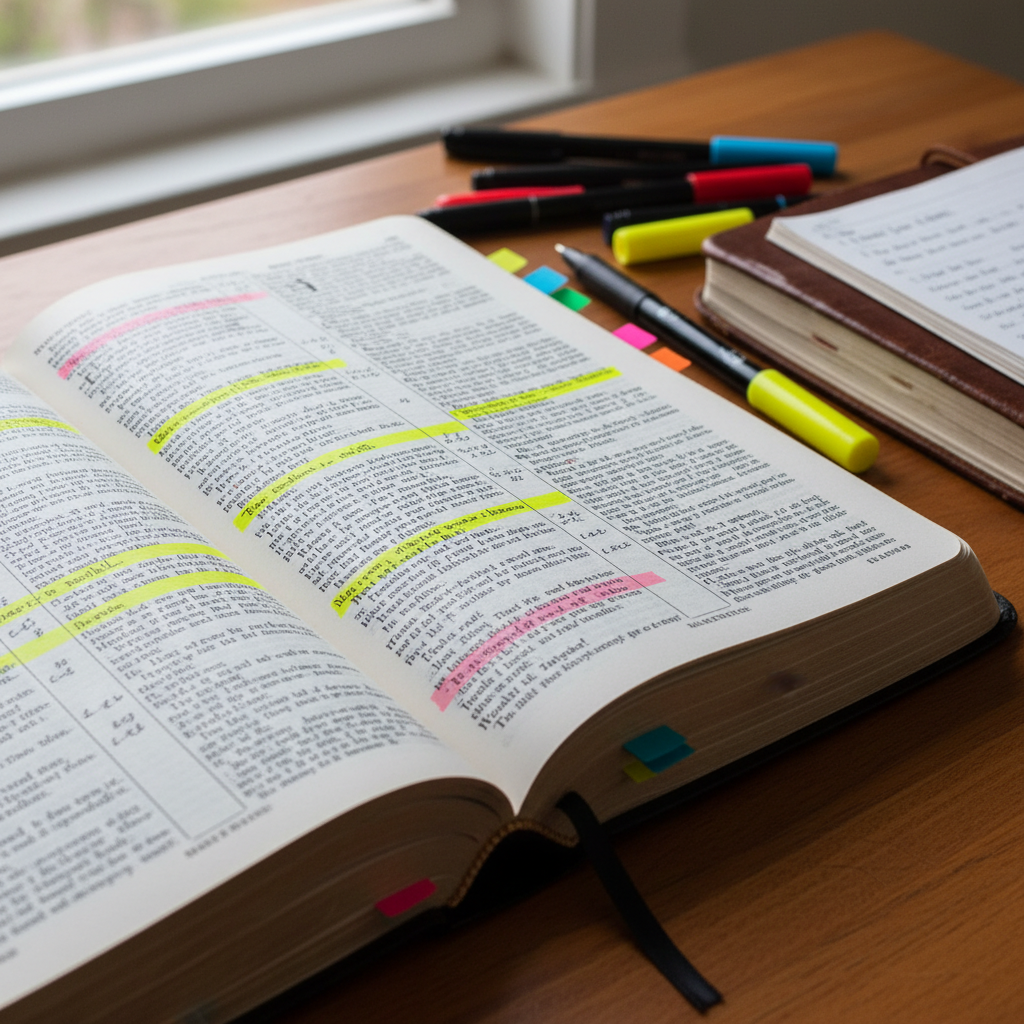
The foundation of good Bible study is careful observation. Read the passage multiple times and ask these questions:
- Who is speaking? Who is the audience?
- What is happening? What is being taught?
- When did this take place? What’s the historical setting?
- Where is this happening geographically?
- Why is the author writing this? What’s the purpose?
- How does this connect to the surrounding passages?
Don’t rush this step. Most people skip observation and jump straight to application, which leads to misinterpretation. Let the text speak for itself first.
Step 4: Interpret in Context
The most common Bible study mistake is taking verses out of context. Always interpret Scripture by considering:
- Literary context: What comes before and after the passage?
- Historical context: What was happening culturally and historically?
- Grammatical context: What do the original Hebrew or Greek words mean?
- Biblical context: How does this fit with the rest of Scripture?
A key principle: Scripture interprets Scripture. If your interpretation of one verse contradicts clear teaching elsewhere in the Bible, revisit your interpretation.
Step 5: Apply the Truth to Your Life
Bible study that doesn’t lead to transformation is incomplete. James 1:22 warns us to be “doers of the word, and not hearers only.”
After studying a passage, ask yourself:
- Is there a command to obey?
- Is there a promise to claim?
- Is there a sin to confess or avoid?
- Is there an example to follow?
- Is there a truth about God’s character to worship?
Essential Bible Study Tools
You don’t need a seminary library to study effectively, but a few tools make a huge difference:
- A study Bible (ESV Study Bible, NASB Study Bible, or the Schocken Bible for Torah study)
- A concordance (Strong’s Exhaustive Concordance for word studies)
- A Bible dictionary (for understanding cultural and historical terms)
- Cross-reference tools (Treasury of Scripture Knowledge or an online tool like Blue Letter Bible)
- A journal for recording your observations and prayers

Tips for Staying Consistent
The biggest challenge isn’t knowing how to study the Bible — it’s doing it regularly. Here’s what works:
- Set a specific time. Morning works best for many, but choose what’s realistic for you.
- Start small. 15 minutes of focused study beats an hour of distracted reading.
- Find accountability. Join a small group or study with a partner.
- Keep a journal. Writing cements what you learn.
- Don’t skip hard passages. The difficult texts often yield the richest insights.
Frequently Asked Questions
How long should I spend studying the Bible each day?
Start with 15-20 minutes of focused study. Quality matters more than quantity. As you build the habit, you’ll naturally want to spend more time. Many seasoned students study for 30-60 minutes daily.
What’s the difference between reading the Bible and studying it?
Reading covers more ground — you might read several chapters at once. Studying goes deep into a smaller passage, examining context, original languages, cross-references, and application. Both are important, and the best habit includes both.
Do I need to know Hebrew and Greek to study the Bible?
No. While knowledge of the original languages is helpful, tools like Strong’s Concordance and interlinear Bibles make original-language insights accessible to everyone. Free online tools like Blue Letter Bible provide word study resources.
Where should a beginner start studying the Bible?
The Gospel of John is an excellent starting point — it clearly presents who Yeshua (Jesus) is and why He came. From there, consider Genesis (to understand the foundation) and Romans (for a systematic overview of the faith).
Frequently Asked Questions
How long should I spend studying the Bible each day?
Start with 15-20 minutes of focused study. Quality matters more than quantity. As you build the habit, you’ll naturally want to spend more time. Many seasoned students study for 30-60 minutes daily.
What’s the difference between reading the Bible and studying it?
Reading covers more ground — you might read several chapters at once. Studying goes deep into a smaller passage, examining context, original languages, cross-references, and application. Both are important, and the best habit includes both.
Do I need to know Hebrew and Greek to study the Bible?
No. While knowledge of the original languages is helpful, tools like Strong’s Concordance and interlinear Bibles make original-language insights accessible to everyone. Free online tools like Blue Letter Bible provide word study resources.
Where should a beginner start studying the Bible?
The Gospel of John is an excellent starting point — it clearly presents who Yeshua (Jesus) is and why He came. From there, consider Genesis (to understand the foundation) and Romans (for a systematic overview of the faith).
Ready to go deeper? At Founded in Truth Fellowship, we offer weekly Bible study groups where you can learn alongside a community of believers. Visit us or contact us to learn more.
Continue Your Bible Study Journey
Ready to Go Deeper?
Join Founded in Truth Fellowship for weekly Bible study and authentic community.
Visit Founded in Truth Fellowship
Join us for Bible study and worship in Rock Hill, SC
Address: 1689 Springsteen Rd, Rock Hill, SC 29730
Phone: (803) 627-8623