
Article
Who Are the 144,000 in Revelation 7 and 14?
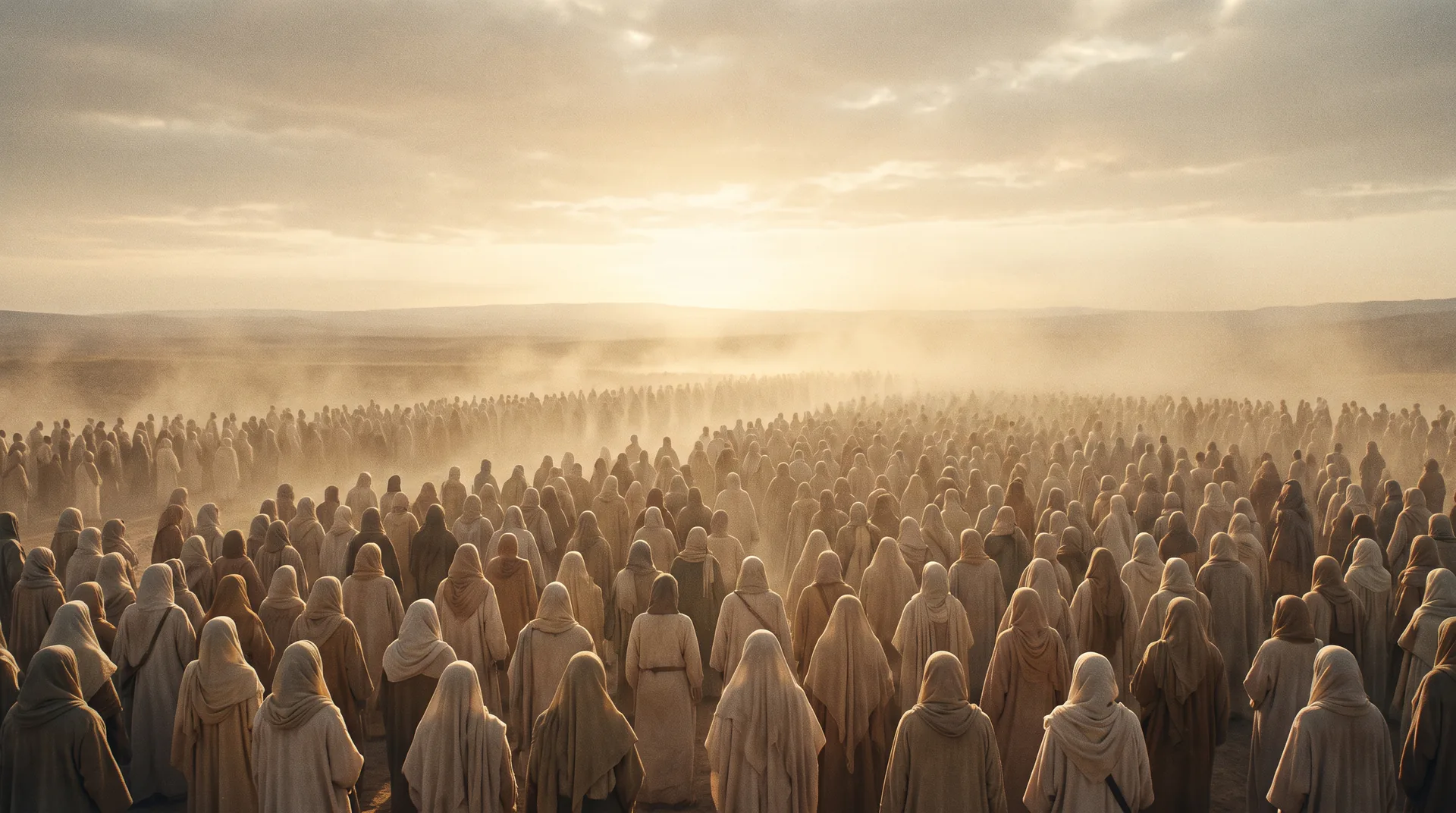
The 144,000 in Revelation 7 and 14 are the whole covenant people of God, every generation of faithful witnesses, pictured as an army mustered for battle. The number is symbolic rather than a headcount. John makes this explicit in the same chapter: he hears the number 144,000, then he turns and sees "a vast multitude from every nation, tribe, people, and language, which no one could number" (Revelation 7:9). That is not a second group. It is the same group, described twice, from two sides of the same battle.
If you have been told the 144,000 are a restricted quota of Jewish evangelists, or a shortlist of one denomination, the text itself pushes back. Here is what Revelation actually does with the number.
Where the 144,000 appear
The number shows up twice. In Revelation 7 the four winds of destruction are held back until a seal is placed on God's servants: "Don't harm the earth or the sea or the trees until we seal the servants of our God on their foreheads." Then John writes, "And I heard the number of the sealed: 144,000 sealed from every tribe of the Israelites" (Revelation 7:3-4), followed by a list of twelve tribes.
In Revelation 14 the same group is standing with the Lamb: "Then I looked, and there was the Lamb, standing on Mount Zion, and with him were 144,000 who had his name and his Father's name written on their foreheads" (Revelation 14:1). They sing a song no one else can learn, and they are called "the firstfruits for God and the Lamb" (Revelation 14:4).
The number is symbolic
Revelation is a book soaked in numbers that carry meaning rather than arithmetic: three and a half, forty two, seven, two witnesses, 666. There is no reason to read 144,000 differently.
The math is a sermon: twelve, the number of the covenant people, multiplied by twelve, multiplied by a thousand. A thousand in Scripture regularly signals a full and uncountable amount, not a tally. God owns "the cattle on a thousand hills" (Psalm 50:10), which does not mean hill number 1,001 belongs to someone else. He keeps covenant "for a thousand generations with those who love him" (Deuteronomy 7:9). Twelve times twelve times a thousand is the covenant people, complete, beyond counting.
The seal is the opposite of the mark
The seal on the forehead in Revelation 7 has a direct Old Testament parallel. In Ezekiel 9, before judgment falls on Jerusalem, God tells a man dressed in linen, "put a mark on the foreheads of the men who sigh and groan over all the detestable practices committed in it" (Ezekiel 9:4). The mark identifies the people who are grieved by the corruption around them.
Notice what the seal does and does not do. It does not remove anyone from the trouble. The great multitude in Revelation 7:14 are "the ones coming out of the great tribulation." The seal carries them through it rather than around it. It marks ownership and allegiance, which is exactly why it functions as the mirror image of the mark of the beast later in the book.
The tribe list is a war census
The list of tribes in Revelation 7 is not the standard birth order you find in Genesis. It follows the pattern of a military census, the kind taken in Numbers 1, where Moses is told to register those "twenty years old or more by their military divisions," everyone able to serve in Israel's army (Numbers 1:3).
That is the key to the image. The 144,000 are not a spiritual VIP list. They are troops being counted before a battle. And when you read the list closely, two things jump out. Set John's roster beside Moses's below and tap Show the differences. Four names are marked: Dan and Levi, which are the two that matter, and Joseph standing where Ephraim stood, which is only a difference in how Joseph's house is named.
Revelation 7:5-8, in John's order
Numbers 1:20-43, the war census Moses took
Tap a name to read its note.
Every name, with its note
- Judah John starts here, not with the firstborn. Judah was fourth on the Numbers 1 roster with 74,600 men, the largest count of the twelve.
- Reuben The firstborn, and first on the Numbers 1 roster with 46,500 men. In Revelation 7 he is second, behind Judah.
- Gad 45,650 men in Numbers 1, the smallest count after Manasseh and Benjamin.
- Asher 41,500 men in Numbers 1.
- Naphtali 53,400 men in Numbers 1.
- Manasseh 32,200 men in Numbers 1, the smallest count of the twelve. He is listed here alongside Joseph rather than alongside Ephraim.
- Simeon 59,300 men in Numbers 1.
- Levi The name that should not be on a war roster. Numbers 1:47-49 has God tell Moses not to register Levi with the other Israelites, and yet here Levi is, mustered with everyone else.
- Issachar 54,400 men in Numbers 1.
- Zebulun 57,400 men in Numbers 1.
- Joseph Numbers 1 counts Joseph's two sons separately, Ephraim and Manasseh. Revelation 7 keeps Manasseh and puts Joseph where Ephraim stood.
- Benjamin 35,400 men in Numbers 1, and the last name on both lists.
- Reuben (Numbers 1:20-43, the war census Moses took) 46,500 men able to serve.
- Simeon (Numbers 1:20-43, the war census Moses took) 59,300 men able to serve.
- Gad (Numbers 1:20-43, the war census Moses took) 45,650 men able to serve.
- Judah (Numbers 1:20-43, the war census Moses took) 74,600 men able to serve.
- Issachar (Numbers 1:20-43, the war census Moses took) 54,400 men able to serve.
- Zebulun (Numbers 1:20-43, the war census Moses took) 57,400 men able to serve.
- Ephraim (Numbers 1:20-43, the war census Moses took) 40,500 men able to serve. Revelation 7 does not name Ephraim; Joseph stands in that place.
- Manasseh (Numbers 1:20-43, the war census Moses took) 32,200 men able to serve.
- Benjamin (Numbers 1:20-43, the war census Moses took) 35,400 men able to serve.
- Dan (Numbers 1:20-43, the war census Moses took) 62,700 men able to serve, the second largest tribe in the census, and the name Revelation 7 leaves out. Some early writers claimed it was because the Antichrist would come from Dan, but Scripture does not say so.
- Asher (Numbers 1:20-43, the war census Moses took) 41,500 men able to serve.
- Naphtali (Numbers 1:20-43, the war census Moses took) 53,400 men able to serve.
Dan is missing. Some early writers claimed this was because the Antichrist would come from Dan, but there is nothing in Scripture that says so. The honest answer is that the text does not tell us.
Levi is included. Levi was deliberately excluded from the war census of Numbers 1. Levi does not belong on an army roster, and yet here Levi is, mustered with everyone else. The point lands hard: God will call, equip and seal anyone he pleases. If your reaction to seeing a certain name on God's list is resentment, that reaction is worth examining. The tribe left out of this list is the one that is not there.
John hears a number and sees a multitude
Revelation trains you to expect this move. In chapter 5, one of the elders announces "the Lion from the tribe of Judah, the Root of David, has conquered" (Revelation 5:5). John turns to look and sees "one like a slaughtered lamb" (Revelation 5:6). He hears Lion and sees Lamb, and both are true.
Chapter 7 repeats the pattern exactly. He hears 144,000. He turns and sees a countless multitude in white robes with palm branches. The army counted before the battle is the innumerable victorious crowd after it. Same people, two scenes.
The palm branches and the language of God spreading his shelter over them (Revelation 7:15) point to the Festival of Shelters, the feast Zechariah says all the nations will one day come up to keep (Zechariah 14:16). The white robes washed in the blood of the Lamb are priestly language, tying back to the opening of the book where Jesus "made us a kingdom, priests to his God and Father" (Revelation 1:5-6), which is itself Exodus 19:6.
How this army fights
They win, and they never pick up a weapon. "They conquered him by the blood of the Lamb and by the word of their testimony; for they did not love their lives to the point of death" (Revelation 12:11). The Greek word behind "testimony" is the one we get the word martyr from. Victory in Revelation is faithful witness under pressure, not force.
Revelation 14:4 describes them as men who "have not defiled themselves with women, since they remained virgins." Read in a book that spends chapters describing spiritual unfaithfulness as fornication with Babylon, that is purity language, not a biological requirement, and not a men-only club. Both men and women are in the army of God.
What the text does define plainly is endurance: "This calls for endurance from the saints, who keep God's commands and their faith in Jesus" (Revelation 14:12).
Frequently Asked Questions
Is the 144,000 a literal number?
No. It is twelve times twelve times a thousand, a symbolic figure for the complete covenant people of God. John identifies the same group four verses later as a multitude "which no one could number" (Revelation 7:9), which rules out a fixed quota.
Are the 144,000 in the Bible only Jewish people?
The list is drawn from the tribes of Israel, but Revelation reads Israel the way the rest of the New Testament does, as the covenant family that now includes believers from every nation. The parallel vision names them as coming "from every nation, tribe, people, and language."
What is the difference between the 144,000 in Revelation 7 and Revelation 14?
Timing within the vision, not identity. Revelation 7 shows them sealed and counted before the conflict. Revelation 14 shows them standing with the Lamb on Mount Zion, marked with his name, singing a song of the redeemed.
Does the seal protect them from the tribulation?
Not physically. They are explicitly "the ones coming out of the great tribulation" (Revelation 7:14). The seal marks whose they are and carries them through it.
Watch the full teaching
This article summarizes a longer verse-by-verse study from Founded in Truth Fellowship.
Watch: Revelation: The 144,000 in Revelation 7 and 14
Sermon notes (PDF): Revelation: The 144,000 in Revelation 7 and 14