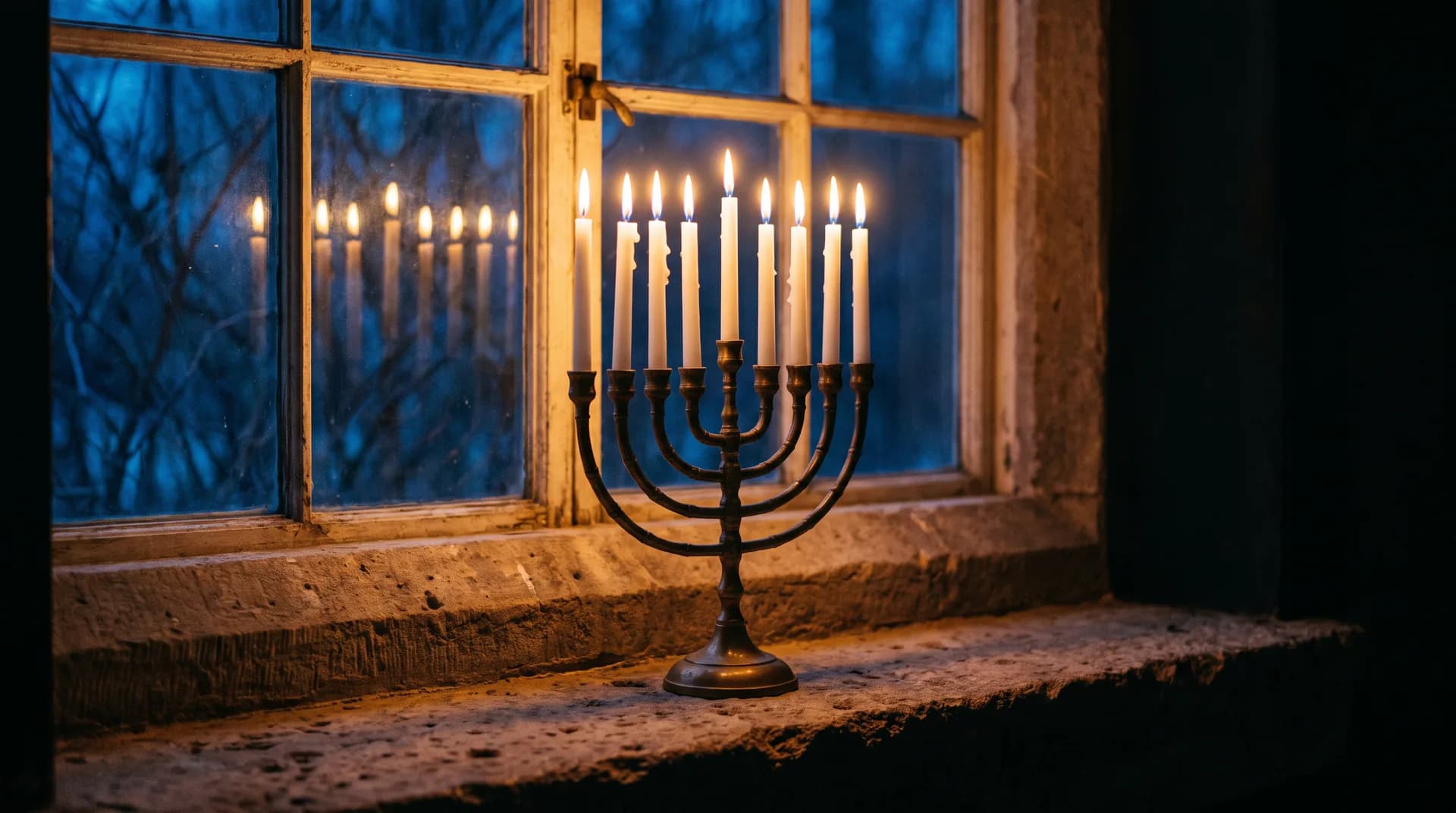
A nine-branch brass hanukkiah burning on a worn stone windowsill, its flames warming the stone while winter dusk stays blue behind the glass

The Feast of Dedication

Hanukkah חֲנֻכָּה

Hanukkah 2026 starts with the first candle at sundown on Friday, December 4, 2026, and runs eight nights to the eighth candle at sundown on Friday, December 11, 2026. Eight nights of remembering the light that should have died and did not.

Counting down

Until the first candle

Days
Hours
Minutes
Seconds

Eight nights

One more candle, every night.

Nothing about Hanukkah happens all at once. Step through the nights and watch the light climb.

First candle: Friday, December 4, 2026 after sundown.

Candles are placed right to left, and lit left to right, so the newest candle is always the first one lit. The raised centre candle is the shamash, the one used to light the rest.

None lit yet

What is it?

The word just means dedication.

Hanukkah is a Hebrew word. It means to dedicate, and it is also the name of the feast: the Feast of Dedication. Underwhelming as an explanation, and it is the whole point of the day.

The history sits between the Testaments. Antiochus IV, a Greek king, marched into Jerusalem, walked into the temple, and carried the menorah, the altar of incense and the table of showbread home as souvenirs. He rededicated God’s house to Zeus and set about erasing Jewish life by force. A priestly family, the Hasmoneans, decided they were done taking it. The fighting ran about three years before that small army took Jerusalem and the temple back.

Then comes the part people skip. The altar had been defiled, and they could not keep offering on it. They also could not just throw the stones in a dump, because holy things stay holy. So they stored them in a chamber in the temple, built a new altar, made new utensils, wove new curtains, and lit the menorah for the first time in three years. That is what Hanukkah celebrates: the moment the light should have died and did not.

Why eight days? They went back to 1 Kings and read how Solomon dedicated the first temple during the eight days of Sukkot. They had missed Sukkot that year, hiding in mountains and caves, so they kept an eight-day dedication in the same pattern. 2 Maccabees 10 says exactly that.

And why keep it every year? 1 Maccabees 4:59 gives the reason: “Then Judas and his brothers and all the assembly of Israel determined that every year at that season, the days of dedication of the altar should be observed with joy and gladness for eight days, beginning on the 25th day of the month of Kislev.” Not the military victory. The dedication. Every year they would remember that no matter how far it went, rededication was never out of reach.

Where it shows up in Scripture

Not in Leviticus 23. Still in the Bible.

Leviticus 23 lists God’s appointed times, and Hanukkah is not one of them. It is not commanded in the Torah. People bring that up as though it settles something. It does not settle much: there is nothing in the Torah about posting comments on Facebook either, and yet there people are.

Being uncommanded is not the same as being unimportant. John clearly did not think of Hanukkah as minor. He treats it the way he treats Passover and Sukkot, as a feast that points at Yeshua. And the Torah does have a dedication of its own: in Numbers 7 the leaders of Israel bring a dedication gift when the altar is anointed. The idea of dedicating an altar to God is older than the Maccabees by a long way.

One more honest note, because it usually comes up. The famous story of a single cruse of oil burning for eight days is a Jewish tradition from several hundred years later. It is not found in either book of Maccabees. It is a good story. It is the Hallmark version, and it is not why Hanukkah exists.

Jesus and Hanukkah

He is standing in Solomon’s Colonnade.

“Then the Festival of Dedication took place in Jerusalem, and it was winter. Jesus was walking in the temple in Solomon’s Colonnade.”

John 10:22–23, CSB

John does not mention that by accident. The gospel writers did not have to tell us everything that happened. They picked. John is the one who frames Yeshua against the feasts on purpose: the bread of life when the crowd is hungry near Passover, living water at Sukkot where the water-pouring ceremony was, and now this. He is telling you what season it is because the season is the argument.

The crowd asks the obvious question. “How long are you going to keep us in suspense? If you are the Messiah, tell us plainly.” (John 10:24) And He answers with sheep. “My sheep hear my voice, I know them, and they follow me. I give them eternal life, and they will never perish. No one will snatch them out of my hand.” (John 10:27–28) Then the line that ends the conversation: “I and the Father are one.” (John 10:30)

Nobody asks a follow-up question. Nobody says, wait, what do you mean by that. “Again the Jews picked up rocks to stone him… ‘We aren’t stoning you for a good work, but for blasphemy, because you, being a man, make yourself God.’” (John 10:31–33) Everyone in the room understood the same thing at the same time. You do not say that here.

Now put that sentence back in its week. Who else claimed to be God in the Hanukkah story? Antiochus. A man calling himself God, and Israel rejected him and was right to. Here is the true presence of God in human form, standing in the courts at the feast that celebrates throwing Antiochus out, and this group rejects Him too. They cannot tell the fake from the real.

And listen to how He defends Himself: “do you say, ‘You are blaspheming’ to the one the Father set apart and sent into the world” (John 10:36). Set apart. Sanctified. Dedicated. He says it standing in the temple whose altar was rededicated at this very feast. The thing the day is named after, He is claiming to be.

Look at where John parks Him, too. Solomon’s Colonnade is the place the Greeks trampled, the place where the abomination happened. That is where He stands as the good shepherd, in the middle of Israel.

Empires can destroy temples. They can steal menorahs. They can kill prophets and execute revolutionaries. They still cannot put out the light of God made flesh.

The menorah in the temple was meant to burn day and night as the sign that God was home. Antiochus put it out for three years. They cleaned the house and relit it. Then Rome destroyed the temple in 70 CE and carried the menorah off as spoils, and you can still see it being carried on the victory arch in Rome. The physical lamp kept going out.

Which is why the light language in John is Hanukkah language. “I am the light of the world. Anyone who follows me will never walk in the darkness but will have the light of life.” (John 8:12) And from the opening of the book: “That light shines in the darkness, and yet the darkness did not overcome it.” (John 1:5) He is not hijacking the festival. He is saying this is what it was always about.

John had already set this up. Early in the book Yeshua says “Destroy this temple, and I will raise it up in three days,” and John stops to explain it for us: “But he was speaking about the temple of his body.” (John 2:19, 21) The house of God became a body. The one place the Maccabees fought three years to get back is now walking around in Galilee.
How we keep it

What we do, and what we do not do.

Plenty of people arrive at this one unsure. It is not in the Torah, so do I do it or not? That is a fair question and it has an easy answer: nobody has to. We keep it, we say out loud that it is not commanded, and we do not pretend otherwise.

We light the candles

Eight nights, at home, with our families. We turn every light in the house off first, because you see the darkness best when there are two or three little flames in the corner pushing it back. Then dreidel, fried food, and telling the kids the story.

We tell the truth about the traditions

The dreidel is not ancient. It came out of a medieval European gambling game played at Christmas, about 1,600 years after the Maccabees, and Jewish families put Hebrew letters on it and used it to teach their kids about God. Latkes are from Poland. We keep them anyway, and we say where they came from.

We do not use it to swing at Christmas

There was a stretch in the messianic world built on fabricated history, where saying Merry Christmas made you an idolater and even hanging lights was suspect. Much of it traced back to one 1800s book that was discredited as soon as real archaeology showed up. We are not doing that here.

And do not stress about doing it right. You are not performing a ritual, you are remembering. Same as Passover, same as Sukkot: so that you will remember the story of who your God is and teach it to your children. The light should have gone out and it did not. That is the story.

If you want the day to cost you something, here is the ask the feast itself makes. The Maccabees tore down a defiled altar and built a new one. So look at your own. What has come into your life that has defiled what you are offering God? Everybody has the shoebox in the corner of the closet they would rather ignore. God can meet you where you are, but not where you are pretending to be. If something needs a sledgehammer, this is the season for it.

If you join us

What to expect.

We gather on Saturdays, and whatever is scheduled for this year’s Feast of Dedication is on the calendar. We livestream as well.

A teaching that does the history

Antiochus, the Hasmoneans, the altar stones, the books of Maccabees, and then John 10. We go into it rather than skate over it. Come with questions.

Family and food

Kids are the heartbeat here. There is fried food, there are candles, and there is no dress code. Come exactly as you are.

A reason to rededicate

The whole feast is about a house being cleaned and given back to God. Expect to be asked what that looks like in your own life, and expect somebody to pray with you about it if you want that.

Honest answers

Questions people actually ask

When is Hanukkah 2026?

Hanukkah 2026 begins with the first candle at sundown on Friday, December 4, 2026. It runs eight nights, so the eighth candle is lit at sundown on Friday, December 11, 2026. Like every day on the biblical calendar, each one starts in the evening, not at midnight.

Is Hanukkah in the Bible?

Not in Leviticus 23, and not commanded in the Torah. People use that to write it off. But it is in the Bible: John 10:22 says "Then the Festival of Dedication took place in Jerusalem, and it was winter," and John puts Jesus in the temple courts for it. The history behind the feast is in 1 and 2 Maccabees.

Why was Jesus at Hanukkah?

John does not mention the feast by accident. He is the gospel writer who frames Jesus against the feasts: bread of life at Passover, living water at Sukkot, and at the Feast of Dedication he has Jesus standing in Solomon’s Colonnade saying "I and the Father are one." Hanukkah celebrates a defiled temple being cleansed and rededicated. John is showing you the one the Father set apart, standing in it.

Did the oil really burn for eight days?

That is a good story, and it is a much later Jewish tradition. It is not found in either book of Maccabees. It is eight days because the Maccabees had missed Sukkot that year and patterned the rededication on the eight-day feast Solomon used to dedicate the first temple. Hanukkah means dedication, and that is what the day is actually about.

Do Christians celebrate Hanukkah?

We do, and nobody has to. It is not a commanded feast and we say so plainly. We keep it because the story is true and it is worth telling: the light in God’s house should have gone out, and it did not.

Light the first one with us.

First time keeping Hanukkah? You are exactly who it is for, and there is no wrong way to start. Check the calendar for this year, or plan a visit. After Friday, December 11, 2026, the next first candle is lit at sundown on Friday, December 24, 2027.

All the biblical feasts·Yom Teruah·Yom Kippur·Sukkot